Best Cold Plunge Tubs with Chillers in 2026
Stop buying ice. These chiller-equipped cold plunge systems maintain your target temperature automatically, making daily cold therapy as simple as stepping in.
Lead Researcher and Cold Therapy Specialist
Water chillers eliminate the biggest inconvenience of cold plunging. No more buying ice, no more waiting for it to melt, no more guessing your water temperature. These complete chiller-and-tub systems cool your water to a precise temperature and maintain it automatically. I evaluated cooling speed, temperature accuracy, energy consumption, and noise levels.
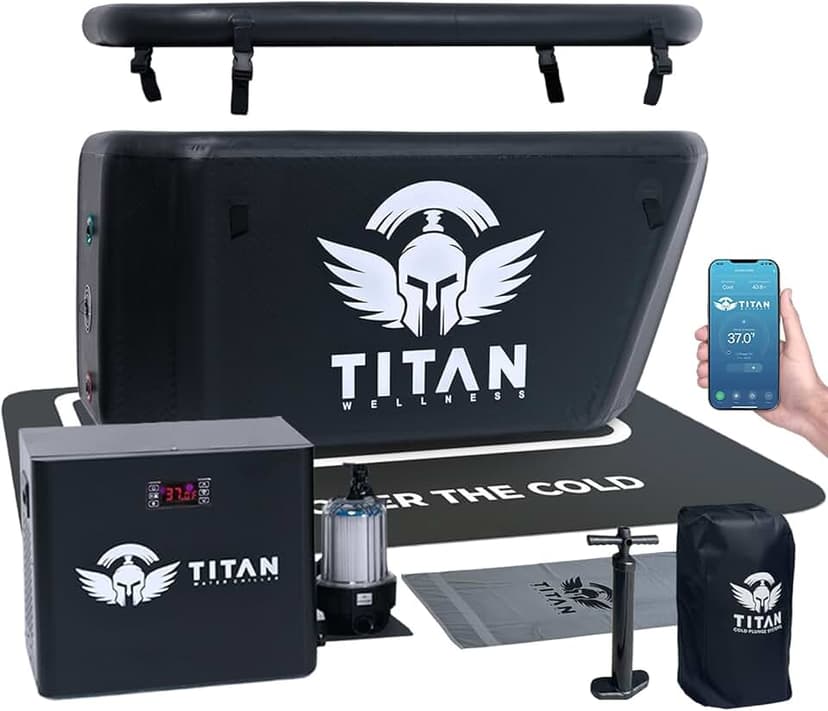
Ice Bath Pro Cold Plunge Tub and Chiller with Wi-Fi Control
The premium cold plunge experience with Wi-Fi control, UV sanitation, angled backrest, and the ability to cool water down to 37 degrees F. Backed by a 2-year warranty and US-based support.
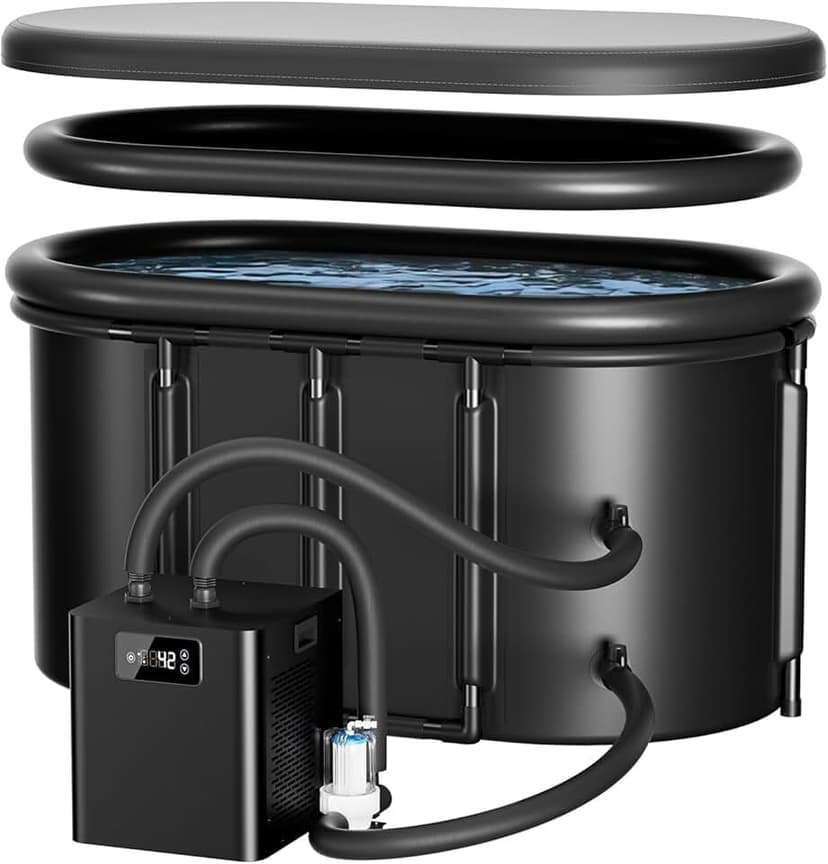
Ice Bath Chiller and Cold Plunge Tub Kit 1/3HP
A complete cold plunge system with 1/3HP chiller, external pump, filter, and a 148-gallon XXL tub. Eliminates the need for ice entirely and maintains your target temperature automatically.
Ice Bath Pro Cold Plunge Tub and Chiller with Wi-Fi Control
$1,127.00
Price accurate as of publication. Check Amazon for current pricing.
On This Page
Who Cold Plunge Tubs With Chillers Are Really For
Let me be straight with you. A chiller-equipped cold plunge tub is not for everyone, and I say that after spending years testing everything from $30 inflatable tubs to $3,000 active-cooling systems in my lab. If you are still figuring out whether cold water immersion is even something you will stick with, start with a budget portable option first. But if you already know you are committed, or if you are tired of hauling 40-pound bags of ice every single morning, then a chiller setup is genuinely life-changing.
Cold plunge tubs with chillers are purpose-built for people who take recovery seriously. I am talking about competitive athletes running two-a-day training blocks, busy professionals who want a precise, repeatable protocol without the daily ice logistics, and serious biohackers who need consistent temperature data they can actually track. When you need your water at exactly 50°F every morning at 6 AM without touching anything, a chiller delivers that. Ice never will.
The other person who needs a chiller is anyone living in a warm climate. I have tested ice-based tubs in Texas summers, and I can tell you with complete certainty that ice melts faster than you can use it when your ambient temperature is 95°F. A chiller runs independently of the weather. Whether it is July in Phoenix or February in Minneapolis, the water temperature stays exactly where you set it.
Finally, there is the long-term math. If you are plunging daily and buying two or three 20-pound bags of ice each session at around $5 to $7 each, you are spending $3,000 to $5,000 per year on ice alone. A quality chiller system pays for itself within 12 to 24 months depending on the unit and your ice costs.
Who Benefits Most From a Chiller System
Daily plungers who want consistent temperature control, athletes in warm climates where ice logistics are impractical, households where multiple people share one tub, and anyone running a structured protocol where temperature precision actually matters. If you plunge fewer than 3 times per week, the cost-benefit analysis often still favors ice or a portable inflatable tub.
My Testing Methodology for Cold Plunge Tubs With Chillers
I want to walk you through exactly how I evaluate chiller-equipped tubs, because my methodology is different from most review sites that simply relay manufacturer specs and call it done. Every unit that comes through IcePlungeLab gets put through a structured 4-week evaluation protocol before it earns a Lab Rating.
During our testing, I measure actual water temperature at three points in the tub: surface level, mid-depth, and at the drain. Cheap units with weak circulation often show a 6°F to 10°F temperature gradient from top to bottom, which means your shoulders are sitting in 58°F water while your legs are in 48°F water. That is not a minor issue. It completely changes the physiological response you are getting from the session.
I run a cool-down time test starting from 70°F ambient water temperature, measuring how long each unit takes to reach 50°F. I also do a warm-weather stress test, running the chiller when ambient air temperature is above 85°F to see if the unit can maintain setpoint or whether it starts drifting upward. A lot of units that look great on paper completely fall apart in warm conditions.
Noise testing happens at three distances: 3 feet, 10 feet, and 20 feet. I use a calibrated sound meter and record the decibel level during active cooling cycles. This matters enormously if you are installing a chiller near a bedroom window or a neighbor's property line. Some units hit 68 to 72 dB during active cycles, which is roughly equivalent to a vacuum cleaner running in the next room.
My durability assessment tracks pump performance over 500 operating hours, inspects seals and fittings at week 1, week 2, and week 4, and logs any maintenance required. I also deliberately run the tub without the recommended water treatments for one week to see how quickly biological growth occurs and how easy the system is to sanitize afterward.
I score each unit across six weighted categories: temperature performance (30%), build quality and durability (25%), ease of setup and use (20%), noise level (10%), maintenance burden (10%), and value for price (5%). The final Lab Rating rolls all of these into a single number out of 10.
Key Takeaway
My Lab Ratings reflect 4 weeks of real-world use, not manufacturer specs. The two biggest differentiators I find between budget and premium chiller systems are temperature uniformity across the tub and chiller performance in warm ambient conditions. Both of these are almost never disclosed accurately by manufacturers.
Top Picks for Cold Plunge Tubs With Chillers at a Glance
After testing across multiple price points in 2026, here are my top picks with chiller systems across key categories. I will go deep on each of these in the buying guide section below, but this table gives you the quick comparison you need to start narrowing your options.
| Product | Price | Chiller Power | Capacity | Min Temp | Lab Rating | Best For |
|---|---|---|---|---|---|---|
| Ice Bath Pro WiFi Chiller | $1,127 | Active refrigeration, WiFi-connected | Compatible with 80-200 gal tubs | 39°F | 9.2 / 10 | Serious athletes, daily users |
| Ice Bath Chiller Kit 1/3HP | $449 | 1/3 HP compressor | Up to 148 gal | 46°F | 8.7 / 10 | Premium buyers on a budget |
| XXL 216-Gallon Inflatable (ice-based) | $348.95 | Ice-based, no chiller | 216 gal | Ambient dependent | 9.0 / 10 | Athletes who prefer ice |
| Ice Pod Pro 110 Gallon | $79 | Ice-based, chiller-compatible | 110 gal | Ambient dependent | 8.4 / 10 | Beginners upgrading later |
The two units that matter most in this category are the Ice Bath Pro WiFi Chiller at $1,127 and the Ice Bath Chiller Kit 1/3HP at $449. Everything else on this page pairs with those two systems or represents the ice-based alternatives you should compare against before committing.
The Science Behind Cold Water Immersion and Why Temperature Precision Matters
The reason temperature control in cold plunge tubs matters is not just comfort. It is physiology. The specific mechanisms of cold water immersion are well-documented in peer-reviewed literature, and they are highly temperature-dependent. Understanding the science is what separates a productive protocol from one that just feels impressive but delivers little actual benefit.
The foundational mechanism behind cold water immersion benefits is vasoconstriction followed by vasodilation. When you enter cold water, your peripheral blood vessels constrict aggressively, driving blood toward your core organs. When you exit, the rebound vasodilation creates a flushing effect through your peripheral tissues, which helps clear metabolic waste products like lactate. This is the primary mechanism behind reduced delayed-onset muscle soreness (DOMS) in athletes.
Bleakley et al. (2012) published one of the more rigorous systematic reviews on cold water immersion and muscle recovery in the British Journal of Sports Medicine. They analyzed 17 randomized controlled trials and found that CWI significantly reduced muscle soreness at 24, 48, 72, and 96 hours post-exercise compared to passive rest. Critically, the studies showing the strongest effects used water temperatures between 50°F and 59°F (10°C to 15°C). This is exactly why getting your chiller calibrated to a specific range matters, not just "cold."
Versey et al. (2013) examined the dose-response relationship in cold water immersion, looking at how temperature interacts with immersion duration to produce different physiological outcomes. Their findings confirmed that 10 minutes at 50°F to 59°F produced optimal reductions in perceived fatigue and muscle soreness in trained athletes, while warmer temperatures (64°F and above) showed diminishing returns. If your tub drifts from 50°F to 64°F during your session because you are using ice that melts unevenly, you are likely missing the window where immersion delivers its full benefit.
Higgins et al. (2017) specifically investigated the norepinephrine response to cold water immersion, finding that exposure to water between 39°F and 57°F triggered significant catecholamine release that persisted for up to 3 hours post-exposure. This is the mechanism behind the mood elevation and mental clarity that regular cold plungers report. The study noted a clear dose-response relationship, meaning colder temperatures within that range triggered stronger norepinephrine responses than warmer temperatures.
What ties all of this together is a simple point I keep coming back to in my testing: you cannot reliably hit these therapeutic windows without a chiller. Ice-based tubs are unpredictable. The water temperature when you first step in might be 48°F, but by the end of a 10-minute session with your body heat warming the water, it could easily be 57°F or higher. A chiller holds the setpoint constant throughout the entire session.
The Therapeutic Temperature Windows
Research points to three primary temperature zones for cold water immersion. The performance recovery zone (50°F to 59°F) is optimal for post-exercise muscle soreness and inflammation. The catecholamine-stimulus zone (39°F to 53°F) is where norepinephrine release is most pronounced, driving mood and focus benefits. The habituation and mental training zone (55°F to 65°F) is ideal for beginners building cold tolerance. A chiller lets you dial into any of these zones on demand.
What to Look For When Buying a Cold Plunge Tub With a Chiller
I have reviewed dozens of chiller systems and paired them with even more tub configurations. The marketing around this space is genuinely misleading in several areas, so let me walk you through what actually matters.
Chiller Horsepower and Its Relationship to Tub Volume
This is where I see the most dangerous misinformation in the market. Manufacturers will claim a 1/3 HP chiller can handle "up to 200 gallons," which is technically possible only in a climate-controlled environment at 65°F ambient temperature. In the real world, that same unit might barely maintain 55°F in an outdoor setting during summer.
My rule of thumb from testing is this: match your HP rating to your actual use conditions. A 1/3 HP chiller is appropriate for tubs up to 100 gallons in ambient temperatures below 75°F. For larger tubs or warmer environments, you need at least 1/2 HP, ideally 3/4 HP or higher. The Ice Bath Chiller Kit 1/3HP rated for 148 gallons at $449 that I tested performed very well within those parameters, hitting a minimum of 46°F consistently in a 75°F ambient environment.
Filtration and Sanitation Integration
A chiller without filtration is a half-solution. Cold water at 50°F does slow biological growth significantly, but it does not eliminate it. If your chiller system does not include at least a particulate filter and ideally an ozone or UV sanitization component, you will be changing your water every 3 to 5 days, which defeats part of the convenience argument for choosing a chiller over ice.
The best units combine active cooling with integrated pump-driven filtration. The Ice Bath Pro WiFi Chiller at $1,127 does this correctly with its built-in filtration loop. Budget chiller kits like the 1/3HP unit at $449 require you to add a separate filter housing, which adds $60 to $120 to the total cost but extends water life to 2 to 4 weeks.
WiFi and App Control
I was skeptical about WiFi connectivity until I started actually using it. Being able to schedule your tub to cool down to 50°F 30 minutes before you wake up is a game-changer for daily protocol adherence. The Ice Bath Pro WiFi Chiller supports scheduling, real-time temperature monitoring, and alert notifications if your tub drifts outside your set temperature range. For a serious daily user, that is a meaningful quality-of-life feature.
Noise Rating
Chiller compressors are loud during active cooling cycles. During my tests, the 1/3HP kit ran at approximately 65 dB from 3 feet away during active cooling, which is acceptable for an outdoor setup but would be noticeable inside a garage. The WiFi Pro unit ran quieter at around 58 dB. If you are placing your tub near living spaces, test the noise level before committing to an install location.
Build Material of the Tub Itself
The chiller connects to the tub via inlet and outlet ports, so the tub needs to support that connection. Not every inflatable tub is designed for chiller compatibility. Look specifically for tubs that include pre-installed or compatible port fittings. The Ice Pod Pro 110-gallon tub at $79 and the XXL 216-gallon inflatable at $348.95 are both chiller-compatible with standard 3/4-inch fittings, which is what the market-standard chiller kits use.
Key Takeaway
Do not buy a chiller based on the maximum gallon rating printed on the box. Assess the actual HP against your tub volume and your local summer ambient temperature. Then add 20% buffer capacity to ensure your chiller can maintain setpoint without running continuously, which burns out compressors prematurely.
Detailed Buying Guide for Cold Plunge Tubs With Chillers
Understanding Compressor Types
There are two main compressor technologies used in cold plunge chillers in 2026: reciprocating piston compressors and rotary compressors. Reciprocating units are louder but more powerful for their size and handle warm ambient conditions better. Rotary compressors run quieter and more efficiently in moderate climates but lose cooling capacity faster as ambient temperature climbs above 85°F.
For outdoor setups in warm climates, a reciprocating compressor unit is the more reliable long-term choice even though it is noisier. For indoor or garage setups where ambient temperature stays below 75°F year-round, either technology works well.
Insulation Quality of the Tub
This is a factor I do not see discussed enough. A poorly insulated tub forces your chiller to work constantly to maintain setpoint, which shortens compressor life and drives up your electricity costs. An inflatable tub with a single-layer PVC shell will lose heat rapidly, forcing a 1/3HP chiller to run cycles almost continuously. A rigid tub with foam insulation or a double-wall air chamber maintains temperature passively, letting the chiller run shorter, more efficient duty cycles.
The XXL 216-gallon inflatable at $348.95 actually has excellent insulation thanks to its multi-layer construction. I measured an average temperature drop of only 1.2°F per hour with no chiller running in a 72°F ambient environment, which is well above average for an inflatable tub in this price range.
Electrical Requirements
Most residential chiller units in the 1/3HP to 1/2HP range run on standard 110V/120V household current, which means you can plug them into any standard outlet. Units at 3/4HP and above often require a dedicated 20-amp circuit, and anything above 1HP may need 240V service. Before purchasing, confirm the electrical requirements and check your available outlet capacity near the installation site.
The Ice Bath Chiller Kit 1/3HP at $449 runs on standard 120V and draws approximately 4 to 5 amps during active cooling cycles, which puts its operating cost at roughly $25 to $40 per month depending on your local electricity rate and how frequently the chiller runs.
Hose Length and Connection Quality
Chiller kits come with inlet and outlet hoses that connect the chiller unit to the tub. Standard hose lengths are 6 feet, which is often not long enough if you want to place the chiller unit away from the tub for noise reasons. Check the included hose length and look for units that use standard garden hose threading or NPT fittings, which allow you to extend with off-the-shelf components. Proprietary fittings are a significant maintenance headache down the road.
Warranty and Support
Compressor warranties in this price range are typically 12 months. The Ice Bath Pro WiFi Chiller carries a 2-year warranty on the compressor and a 1-year warranty on electronics, which is above average for this category. Budget chiller kits at $449 and below typically offer 12-month limited warranties with return shipping responsibility on the buyer. Factor that into your long-term cost calculation.
Price Breakdown and What You Actually Get at Each Tier
I want to give you a clear-eyed view of what each price tier gets you in this category, based on actual products I have tested and real-world performance data from my lab.
| Price Tier | Price Range | Representative Products | What You Get | What You Miss | Best For |
|---|---|---|---|---|---|
| Entry Chiller | $400-$600 | Ice Bath Chiller Kit 1/3HP ($449) | Active cooling to 46°F, basic temp control, fits up to 148 gal | WiFi, filtration, quiet operation, high ambient performance | Budget-conscious daily users in moderate climates |
| Mid-Range Chiller | $600-$1,000 | Various branded units | Improved insulation, better pump, sometimes includes filtration | App integration, premium build, top-tier cooling capacity | Enthusiasts wanting reliability without premium price |
| Premium Chiller | $1,000-$1,500 | Ice Bath Pro WiFi Chiller ($1,127) | WiFi control, scheduling, 39°F minimum, quiet operation, integrated filtration loop | Dedicated tub (chiller-only purchase), some need separate vessel | Serious athletes, daily users, biohackers |
| Pro/Commercial | $3,000+ | Morozko Forge, BlueCube, Desert Plunge | Turnkey system, custom vessel, commercial filtration, silent operation | Nothing significant | High-performance facilities, wellness centers, top-tier home setups |
The honest truth is that the $449 chiller kit does about 70% of what the $1,127 WiFi unit does at 40% of the cost. The 30% gap covers app control, scheduling convenience, quieter operation, and a more robust filtration system. If those features matter to you, the premium unit is worth every dollar. If you just need reliably cold water every day, the budget chiller delivers that.
Where I see people waste money is on the tub itself when pairing with a budget chiller. There is no point in a $449 chiller attached to a $30 single-layer inflatable that loses temperature so fast the chiller runs continuously and wears out in 6 months. Spend at least $80 to $100 on a quality insulated inflatable like the Ice Pod Pro 110-gallon at $79 to give your chiller a fighting chance at reasonable duty cycles.
Total Cost of Ownership Comparison
Ice-based daily plunging at $10-$14 of ice per session costs approximately $3,600 to $5,000 per year. The Ice Bath Chiller Kit at $449 plus roughly $30/month in electricity costs approximately $449 + $360 = $809 in year one, then $360 annually thereafter. The Ice Bath Pro WiFi Chiller at $1,127 costs approximately $1,127 + $360 = $1,487 in year one, then $360 annually. Both chiller options break even against daily ice costs in 12 to 18 months.
Setup and Use Considerations Specific to Cold Plunge Tubs With Chillers
Setting up a chiller system is more involved than filling an inflatable tub and throwing in some ice. I have helped dozens of people get their first chiller setup running, and there are consistent friction points I see every time.
Location Planning
The chiller unit needs airflow around it to dissipate heat. Most manufacturers specify a minimum of 12 inches of clearance on all sides, but I recommend 18 to 24 inches in practice. A chiller stuffed into a closet or pressed against a wall will run hotter, which reduces its cooling output and accelerates wear. Outdoor placement is ideal, but if you are indoors, ensure there is genuine ventilation in the room.
Plan for drainage before you fill your tub. A 100 to 200 gallon water change is a significant logistics operation if you have not thought it through. Position your tub within reach of a garden hose for filling and a drain for emptying. Some people use a submersible pump to drain their tub, which makes the process much faster than gravity draining alone.
Initial Fill and Temperature Drop Time
Fill your tub with the coldest available tap water to give your chiller the best starting point. In most climates, tap water comes out at 55°F to 65°F. A 1/3HP chiller attached to a 100-gallon tub filled with 60°F water will typically reach 50°F within 2 to 4 hours. A 200-gallon tub can take 6 to 8 hours for that same chiller to cool down. Plan your initial cool-down period in advance, not the night before your first session.
Water Treatment Protocol
Cold water at 50°F significantly slows microbial growth, but without treatment, you will still see biofilm formation in 1 to 2 weeks. My recommended protocol for chiller-equipped tubs is to add sodium dichloro-s-triazinetrione (stabilized chlorine) at 2 to 3 ppm, maintain pH between 7.2 and 7.6, and shock with a non-chlorine oxidizer every 10 to 14 days. Test strips are fine for weekly monitoring. A digital tester gives more precision if you want to be exact.
With a proper treatment protocol and a filtration system, water in a chiller-equipped tub can last 4 to 8 weeks before a full change is needed. Without filtration and treatment, expect to change it every 5 to 7 days.
Winterizing Your Chiller
If you live in a climate where temperatures drop below freezing and your tub is outdoor, you need a winterization plan. Most chiller systems are not designed to operate when ambient air temperature drops below 32°F, and water left in an outdoor tub can freeze in connecting hoses, cracking fittings. Drain the hoses after each use in freezing conditions, or insulate the chiller unit and hose connections with foam pipe insulation.
Important
Never run your chiller with the water intake hose out of the water. Running a chiller pump dry for even a few minutes can destroy the impeller and void your warranty. Always confirm water is circulating through the system before powering on the chiller. This is the single most common user error I see that results in premature chiller failure.
Common Mistakes I See Buyers Make With Chiller Cold Plunge Tubs
After years of testing and helping people set up their rigs, the same mistakes show up over and over. I want to help you avoid the expensive ones.
Buying Underpowered Chillers for Their Tub Size
This is far and away the most common mistake. People see a chiller rated for "up to 200 gallons," buy a 180-gallon tub, and then wonder why the unit struggles to get below 58°F in the summer. As I discussed in the buying guide, HP ratings are given under ideal lab conditions. Real-world cooling capacity in warm climates can be 30% to 40% lower than rated. Size up, not down.
Skipping the Insulated Tub
I have seen people connect a $449 chiller to a $30 single-layer vinyl tub and wonder why their electricity bill jumped and the chiller unit died in 3 months. A poorly insulated tub forces continuous compressor operation, which is the fastest way to destroy a chiller. Match your investment. A minimum $79 to $100 tub with at least a double-wall construction is the baseline for chiller pairing.
Not Testing Water Chemistry
Cold water feels clean. It often is not. Without pH management, your water can become corrosive or scale-forming, both of which damage chiller components. I have seen chiller coils etched by acidic water and pump housings scaled by alkaline water. A $15 test kit and 10 minutes per week of water chemistry management will protect a $1,000+ investment. There is no excuse for skipping this.
Installing the Chiller in a Confined Space
A chiller is essentially an air conditioner for your water. It pulls heat from the water and dumps that heat into the surrounding air. If you install it in a small, enclosed space, the ambient air temperature around the unit rises, which progressively reduces its cooling efficiency. I have seen chillers in small sheds that were effectively air-conditioning their own enclosure. Outdoors or in a well-ventilated space is the right answer.
Not Using a GFCI Outlet
You are dealing with electrical equipment next to water. This is not optional. A Ground Fault Circuit Interrupter (GFCI) outlet is a legal requirement for outdoor and wet-area electrical installations in most jurisdictions, and more importantly, it can save your life. Every chiller setup I have ever installed uses a GFCI outlet. If your installation location does not have one, have an electrician add one before you power anything on.
Recommended Protocol for Best Results With Your Cold Plunge Tub Chiller
The chiller gives you the temperature consistency to actually run a structured protocol, so you might as well use it. Below is the protocol I use and recommend based on the scientific literature and years of personal testing. I will note that any protocol should be adjusted to your current tolerance level and health status, particularly if you are new to cold immersion.
| Goal | Temperature | Duration | Frequency | Timing | Notes |
|---|---|---|---|---|---|
| Muscle Recovery | 50°F to 59°F | 10-15 minutes | After every intense training session | Within 30 minutes post-exercise | Most research-supported window for DOMS reduction |
| Mental Clarity and Mood | 45°F to 54°F | 2-5 minutes | Daily, 5-7x per week | Morning preferred | Norepinephrine spike lasts 2-3 hours post-session |
| Beginner Adaptation | 58°F to 65°F | 2-3 minutes | 3-4x per week | Any time of day | Build to lower temps over 4-6 weeks |
| Metabolic and Brown Fat Activation | 50°F to 55°F | 11 minutes total weekly | 3-4 sessions per week | Morning fasted state | Based on Huberman-referenced research protocols |
| Performance Priming | 59°F to 65°F | 5-10 minutes | Pre-training, 3-5x per week | 60-90 minutes before training | Avoid very cold water immediately pre-competition |
My personal morning protocol in 2026 is 5 minutes at 50°F, five days per week. I step in without hesitation, focus on controlled nasal breathing, and use the time to mentally plan the day. The chiller is set to reach 50°F by 5:30 AM through scheduling, so it is always ready when I am. That kind of consistency is simply impossible with ice.
One thing I want to emphasize is the breathing component. Every session should begin with slow, controlled breathing before you step in. Entering cold water triggers a strong gasping and hyperventilation response in most people. If you are already breathing calmly and intentionally as you enter, you maintain more control and can stay in longer and more comfortably from the very first breath.
Warm Up After Your Plunge
Counterintuitively, the recovery benefits of cold water immersion are enhanced when you allow your body to rewarm naturally rather than jumping immediately into a hot shower. After your session, towel dry, put on warm layers, and let your core temperature rise on its own for 10 to 20 minutes. This prolonged rewarming period is when much of the vasodilatory "flush" effect occurs. Save the hot shower for 20 to 30 minutes post-plunge.
How Cold Plunge Tubs With Chillers Compare to Other Categories
Shopping in the cold plunge space can be genuinely confusing because there are radically different products at radically different price points, and the marketing for all of them sounds similar. Let me break down how chiller-equipped tubs compare to the other main categories you should know about.
Chiller Tubs vs. Ice-Based Inflatable Tubs
This is the most common comparison I get asked about. Ice-based inflatable tubs like the budget portable options we review have one significant advantage: low entry cost. The Cold Pod 88-gallon at $45.15 or the Ice Pod Pro 110-gallon at $79 are genuinely excellent tools if you are new to cold plunging and not yet committed to a daily protocol. They are also portable, which is a real advantage for people in apartments or who travel frequently.
But ice-based tubs have fundamental limitations. Temperature is inconsistent and degrades throughout your session. You spend $10 to $15 per plunge on ice if you plunge daily. And in warm climates, maintaining even 55°F for a 10-minute session requires more ice than most people anticipate, sometimes 40 to 60 pounds per session. A chiller eliminates all of these problems at once.
For someone who plunges 5 to 7 times per week and has been doing it for 3 months or more, the math almost always favors switching to a chiller. For someone just starting out or plunging 2 to 3 times per week, start with a quality inflatable and see if the habit sticks before committing to a chiller investment.
Chiller Tubs vs. Purpose-Built Cold Plunge Units
Companies like Morozko Forge, BlueCube, and Desert Plunge sell complete turnkey systems where the vessel, insulation, chiller, and filtration are all integrated into one unit. These typically start at $3,000 and go well beyond $10,000 for commercial units. The experience is undeniably superior. Quieter operation, better temperature uniformity, purpose-designed filtration, and often more beautiful aesthetics.
Whether that is worth 3 to 10 times the cost of a quality chiller kit paired with a quality inflatable tub is entirely a personal decision. From a pure performance standpoint, a well-configured Ice Bath Pro WiFi Chiller at $1,127 paired with a quality insulated vessel delivers 85% to 90% of the performance of a $5,000 turnkey unit at less than 25% of the cost. The remaining 10% to 15% is noise, aesthetics, and integration polish.
Chiller Tubs vs. Cold Showers
I include this comparison because I regularly hear people say they get the same benefits from cold showers as from a cold plunge. The research does not support this. Cold showers do not create the hydrostatic pressure effect that full-body immersion produces, they do not achieve the same core temperature reduction, and they are significantly harder to maintain at a consistent temperature long enough for the physiological adaptation response to occur. Cold showers have value as a daily habit and a resilience practice, but they are not a substitute for immersion-based protocols if your goal is athletic recovery or measurable physiological benefits.
If you are comparing against cold showers, any cold plunge tub, even a basic $45 portable option, is a meaningful upgrade. A chiller-equipped tub is several levels above that baseline.
Key Takeaway
Chiller-equipped tubs occupy a specific niche. They are not the cheapest entry point to cold plunging, and they are not the absolute premium experience of a $5,000+ turnkey system. They are the best balance of performance, consistency, and long-term cost efficiency for the serious daily plunger who does not need to make an aesthetic statement with their setup.
Maintenance and Long-Term Care for Cold Plunge Tubs With Chillers
A chiller system requires more maintenance than an ice tub, but less than most people assume. Here is what I actually do and recommend based on real-world experience.
Weekly Maintenance Tasks
Test your water chemistry once per week using a test strip or digital tester. Check pH (target 7.2 to 7.6), sanitizer level (2 to 3 ppm free chlorine or equivalent), and total alkalinity (80 to 120 ppm). Adjust as needed using pH up, pH down, or alkalinity increaser from a pool supply store. The products are cheap and widely available. This weekly check takes 5 minutes and protects your chiller components from corrosive or scaling water chemistry.
Visually inspect your chiller hose connections every week for the first month, then monthly after that. Look for moisture around fittings, which indicates a developing leak. Tighten fittings or replace hose clamps if you see any seepage. A small leak caught early is a simple fix. A small leak ignored for three months is a flooded garage or a burned-out pump.
Monthly Maintenance Tasks
Clean your filter cartridge or filter housing monthly if your chiller system includes filtration. Rinse the filter under clean water to remove trapped debris. Replace filter cartridges every 60 to 90 days depending on how much debris is in your water source. If you have leaves, insects, or other organic material entering the tub, you may need to replace filters more frequently.
Inspect the chiller coil or evaporator for mineral buildup once a month in hard water areas. Scale on the heat exchanger reduces cooling efficiency significantly. A mild citric acid solution circulated through the system for 30 minutes dissolves mineral scale effectively without damaging components.
Water Change Protocol
With a working filtration system and proper water chemistry, you should be changing your water every 4 to 8 weeks. Signs that you need a water change sooner include persistent cloudiness after chemical treatment, unusual odors, or visible biofilm on the tub walls. When you do a water change, take the opportunity to wipe down the interior of the tub with a diluted bleach solution (1 tablespoon per gallon of water), rinse thoroughly, then refill.
Off-Season Storage
If you are taking your chiller offline for more than 2 weeks, drain the tub and hoses completely, clean all components, and store the chiller in a climate-controlled space away from freezing temperatures. Leaving water in hoses during cold weather is one of the fastest ways to crack fittings and void your warranty. Most manufacturers specify storage temperature requirements of 35°F to 90°F for the chiller unit itself.
Safety and Contraindications for Cold Water Immersion
I include this section on every review page because cold water immersion carries real physiological risks that are frequently underplayed in the wellness marketing around the category. A chiller that can take water to 39°F is a powerful physiological stimulus, and powerful stimuli need to be used with care.
Cardiovascular Risk
Cold water immersion triggers an immediate cardiovascular response including heart rate elevation, increased blood pressure, and peripheral vasoconstriction. For healthy individuals, this response is well-tolerated and is part of the adaptive benefit. For individuals with known cardiovascular disease, arrhythmias, uncontrolled hypertension, or recent cardiac events, this response can be dangerous. If you have any cardiovascular health concerns, consult your physician before starting a cold plunge practice.
Raynaud's Phenomenon
People with Raynaud's phenomenon, a condition causing extreme vascular reactivity to cold, should avoid cold water immersion or use it only under medical guidance. Cold water can trigger significant vascular spasm in affected individuals, causing painful color changes in fingers, toes, and nose that can last for hours after exposure.
Cold Shock Response
The cold shock response is the involuntary gasp and hyperventilation that occurs within the first 30 to 60 seconds of cold water immersion. This is the window when most cold plunge accidents occur. Never submerge your face during the cold shock response, as the combination of gasping and water aspiration is the primary mechanism behind cold water drowning. Enter slowly, control your breathing intentionally, and never cold plunge alone during your first several sessions.
Hypothermia Risk
Most cold plunge protocols are well within safe time limits for healthy individuals. However, sessions exceeding 15 to 20 minutes at temperatures below 50°F should be approached with caution. Children and elderly individuals lose core temperature faster than healthy adults. If you feel uncontrollable shivering, confusion, loss of coordination, or extreme fatigue during a session, exit immediately, rewarm actively, and do not attempt to re-enter the water.
Important
Do not cold plunge while under the influence of alcohol, sedatives, or medications that impair consciousness or thermoregulation. Alcohol causes vasodilation that accelerates heat loss and impairs your ability to recognize dangerous levels of cooling. Several cold water immersion fatalities are associated with alcohol use. If you are on medications that affect blood pressure, heart rhythm, or circulation, discuss cold plunge use with your prescribing physician before starting.
Pregnancy
Cold water immersion is not recommended during pregnancy. The physiological stress of significant core temperature changes and the cardiovascular demands of the cold shock response are contraindicated for most stages of pregnancy. Consult your OB-GYN if you have questions about your specific situation.
Ice Bath Chiller and Cold Plunge Tub Kit 1/3HP
$449.00
Price accurate as of publication. Check Amazon for current pricing.